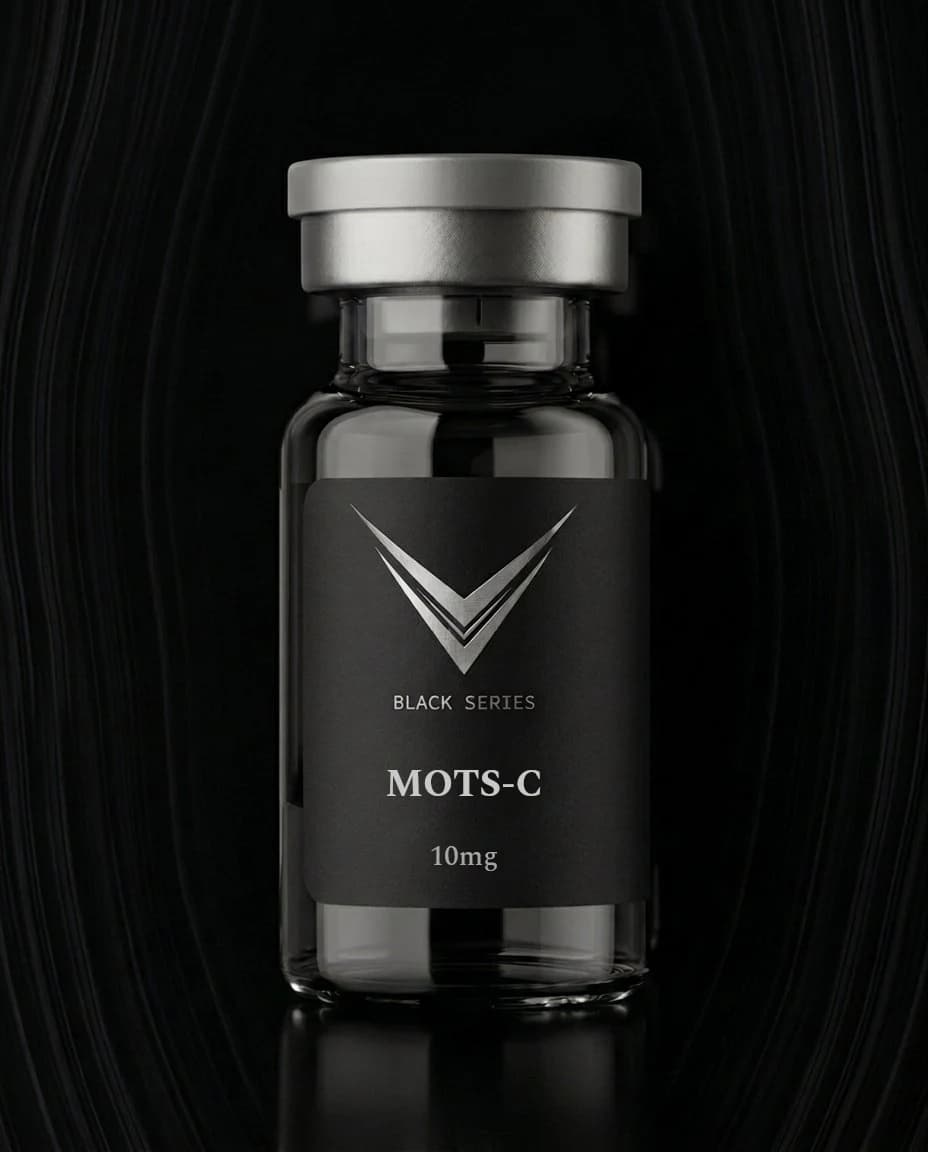
MOTS-c is a synthetic research peptide corresponding to a 16-amino-acid sequence encoded by mitochondrial DNA (mtDNA). It is catalogued under CAS number 1627580-64-6 with a molecular formula of C₁₀₀H₁₅₂N₂₈O₂₂S₂ and a molecular weight of 2174.59 g/mol. The compound is supplied as a lyophilized powder for laboratory research and is intended solely for research purposes, not for human use.
Within the metabolic peptide research field, MOTS-c is notable for its molecular origin: it is among a small class of peptides known as mitochondrial-derived peptides (MDPs) — bioactive sequences whose open reading frames are encoded within the mitochondrial genome rather than nuclear DNA. This origin distinguishes MOTS-c mechanistically from the majority of bioactive peptides studied in research, which are encoded by nuclear genes, and positions it within the emerging literature on mitochondrial-nuclear communication as a signaling axis.
What is unusual about MOTS-c's molecular origin?
Most bioactive peptides studied in research are translated from nuclear-encoded mRNA. MOTS-c is encoded within the 12S ribosomal RNA gene of the human mitochondrial genome — a finding that prompted a reevaluation of what the mitochondrial genome encodes beyond the canonical transfer RNAs, ribosomal RNAs, and 13 oxidative phosphorylation subunit proteins described in classical mitochondrial biology.
The identification of open reading frames within mitochondrial rRNA sequences capable of producing bioactive peptides represents a relatively recent development in the literature. MOTS-c was characterized in this context alongside humanin and SHLP1-6, constituting the mitochondrial-derived peptide class. The implication for research is that mitochondria participate in cellular signaling not only through their metabolic functions but through a peptide-based communication system that published research continues to characterize. MOTS-c is the member of this class most studied for its effects on metabolic signaling pathways.
What is the molecular structure of MOTS-c?
MOTS-c has a molecular weight of 2174.59 g/mol and the molecular formula C₁₀₀H₁₅₂N₂₈O₂₂S₂. It is a 16-amino-acid peptide with the sequence corresponding to an open reading frame in the 12S rRNA-coding region of human mtDNA. The presence of two sulfur atoms in its molecular formula reflects cysteine or methionine residue content within the sequence.
The peptide is produced through solid-phase synthesis and characterized to a purity specification of 99%+ by HPLC. The molecular weight of 2174.59 g/mol places it at a substantially lower mass than larger metabolic research peptides such as GLP-3 (retatrutide, 4731.33 g/mol) or cagrilintide (4409.01 g/mol), consistent with its status as a short, compact 16-residue sequence rather than a lipidated incretin-class analog. The lyophilized form is a white to off-white powder.
What does published research describe about MOTS-c's signaling mechanisms?
Published research describes MOTS-c's primary studied mechanism as activation of AMP-activated protein kinase (AMPK), a central energy-sensing kinase that regulates cellular metabolic responses based on the AMP/ATP ratio. In research models, MOTS-c treatment is associated with AMPK phosphorylation and the downstream metabolic signaling that AMPK activation produces, including effects on glucose and fatty acid metabolism pathways in cell culture and preclinical systems.
A mechanistic detail of particular interest in the MOTS-c literature is its characterization as a nuclear translocating peptide under specific metabolic stress conditions in research models. Published research describes MOTS-c moving from the cytoplasm to the nucleus in response to metabolic perturbation, where it interacts with nuclear regulatory elements. This translocation behavior is studied as part of the mitochondrial-nuclear communication axis rather than as a classical receptor-ligand interaction, and represents a mechanistic mode distinct from the G-protein-coupled receptor pathways that govern the incretin and GH secretagogue classes. Black Series Lab makes no therapeutic or outcome claims regarding MOTS-c; it is studied for its effects on these mitochondrial-nuclear signaling mechanisms in research settings.
How does MOTS-c differ from other metabolic peptides in research?
The defining distinction is mechanistic origin and pathway. The majority of metabolic research peptides studied alongside MOTS-c — GLP-1 receptor agonists, GIP receptor agonists, triple agonists such as GLP-3 — engage class B G-protein-coupled receptors expressed on intestinal L-cells, pancreatic beta cells, and related tissues. MOTS-c does not operate through this incretin-receptor axis. Its studied mechanism centers on AMPK signaling and mitochondrial-nuclear communication rather than incretin pathway pharmacology.
Property
MOTS-c
GLP-3 (Retatrutide)
Cagrilintide
Molecular origin
Mitochondrial DNA (12S rRNA ORF)
Synthetic (nuclear-encoded analog)
Synthetic (amylin analog)
MW (g/mol)
2174.59
4731.33
4409.01
Primary studied mechanism
AMPK activation, mitochondrial-nuclear signaling
GIP/GLP-1/glucagon receptor agonism
Amylin receptor agonism
Receptor class
Not a GPCR ligand (primary mechanism)
Class B GPCR (triple agonist)
Class B GPCR
This mechanistic distinction means MOTS-c is not interchangeable with incretin-class compounds in research designs that aim to isolate a specific metabolic pathway. Researchers interested in the incretin-receptor axis specifically should refer to the GLP-1R signaling bias overview; researchers interested in the GLP-3 multi-receptor profile should see the GLP-3 compound page.
What research models are used to study MOTS-c?
Published research on MOTS-c spans cell culture and preclinical models. In vitro work uses skeletal muscle cell lines, hepatocyte models, and adipocyte systems to characterize the concentration-response profile of MOTS-c's effects on AMPK phosphorylation and downstream metabolic enzyme activity. These cell-culture studies provide mechanistic data on the peptide's behavior at the molecular level, including the translocation dynamics described in the mitochondrial-nuclear signaling literature.
Preclinical animal models have been used to study MOTS-c's effects on metabolic parameters including glucose homeostasis and insulin sensitivity in research contexts. These models characterize systemic metabolic signaling responses rather than individual cell-type mechanisms. The published literature treats these findings as mechanistic characterization of the AMPK and mitochondrial-nuclear signaling axes, not as clinical evidence. The compound is also studied in the context of exercise-associated metabolic stress, where MOTS-c has been detected as a circulating endogenous peptide in published research, supporting its characterization as a physiologically relevant mitochondrial signal.
What stability and handling considerations apply to MOTS-c?
MOTS-c is supplied as a lyophilized powder and stored at −20°C. As a 16-amino-acid peptide containing cysteine or methionine residues (consistent with the S₂ in its molecular formula), it is susceptible to oxidation at those residues under conditions that expose the peptide to atmospheric oxygen. Research handling that preserves compound integrity includes maintaining cold storage, minimizing freeze-thaw cycles, and protecting the lyophilized material from moisture and light.
For the tells that separate a genuine certificate from a fabricated one, see COA red flags, and for what the non-target remainder of a batch consists of, see peptide impurity profiles. This article does not provide reconstitution or preparation protocols; those decisions are made by the researcher according to experimental requirements and applicable regulations.
How does Black Series Lab supply MOTS-c?
Black Series Lab supplies MOTS-c as a research-grade compound characterized to a minimum purity of 99%+ by HPLC, with mass spectrometry identity confirmation. Each batch is documented with a Certificate of Analysis quantifying purity.
Researchers can review specifications, available sizes, and pricing on the MOTS-c product page, or browse the full catalog at all compounds. All material is intended for laboratory research use only and is not for human use.
This compound is a research chemical intended for laboratory and scientific research purposes only. It is not a drug, supplement, or food, and is not intended to diagnose, treat, cure, or prevent any disease. Black Series Lab does not sell products intended for human use. Researchers are responsible for compliance with all applicable local, state, and federal regulations.
Stay in the loop
New compounds, research updates & exclusive subscriber deals.