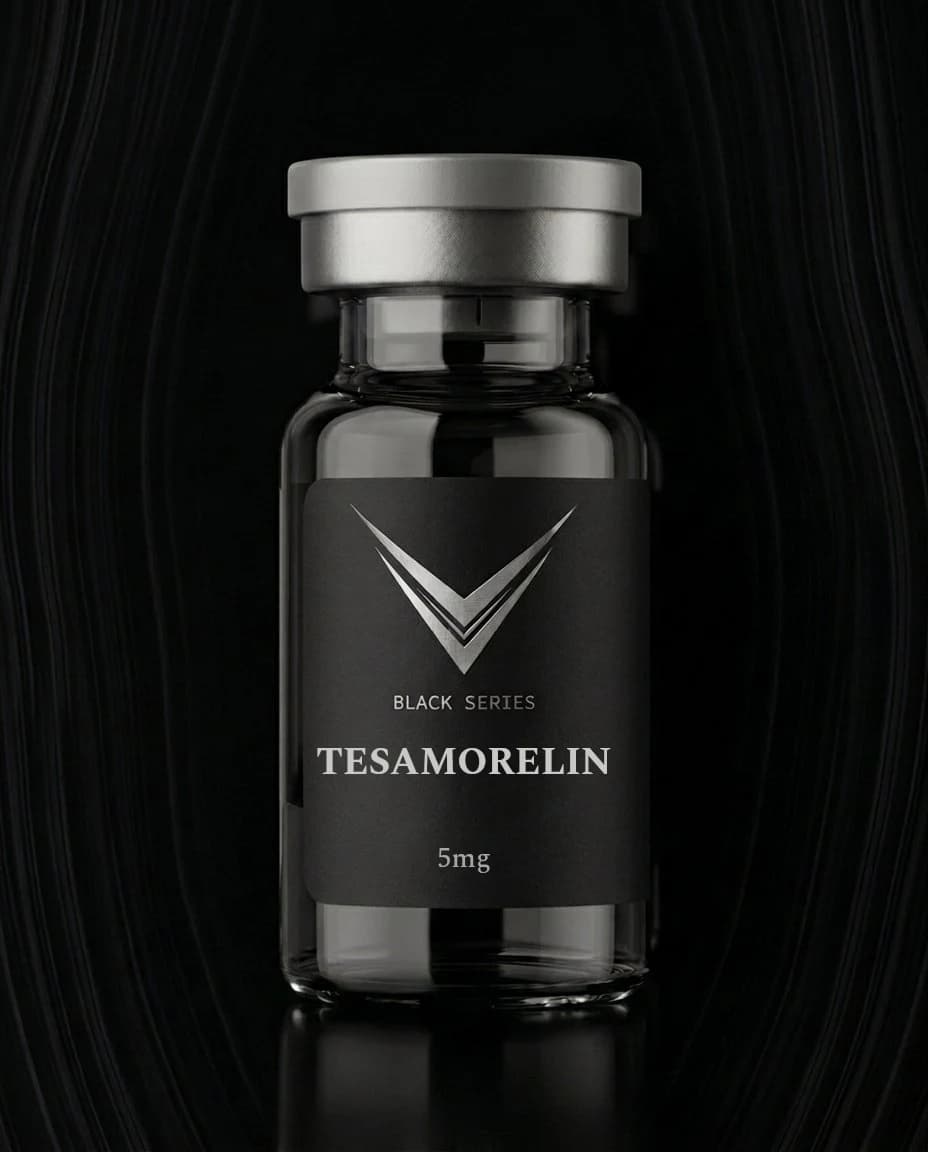
Tesamorelin is a synthetic peptide studied in research as an analog of growth hormone-releasing hormone (GHRH), the endogenous hypothalamic peptide that signals to the anterior pituitary. It is catalogued under CAS number 218949-48-5 with a molecular formula of C₂₂₁H₃₆₆N₆₈O₆₆S and a molecular weight of 5135.89 g/mol. The compound is supplied as a lyophilized powder for laboratory research and is intended solely for research purposes, not for human use.
Within the GH secretagogue research class, tesamorelin is studied for its specific activity at the GHRH receptor — distinguishing it from non-GHRH secretagogues such as ghrelin mimetics, which operate through a separate receptor pathway. This mechanistic distinction is the primary reason tesamorelin occupies its own category within the GH secretagogue research literature rather than being grouped indiscriminately with other secretagogue-class compounds.
What is the molecular structure of tesamorelin?
Tesamorelin has a molecular weight of 5135.89 g/mol and the molecular formula C₂₂₁H₃₆₆N₆₈O₆₆S. The compound is a 44-amino-acid synthetic peptide that recapitulates the sequence of endogenous human GHRH, with structural modifications at the N-terminus that published research associates with enhanced stability relative to the native peptide. This modification is the structural basis for the extended half-life profile observed in pharmacokinetic research models.
The peptide is produced through solid-phase synthesis followed by purification and is characterized to a purity specification of 99%+ by HPLC. The lyophilized form is a white to off-white powder. The molecular weight of 5135.89 g/mol places it at the higher end of the GH secretagogue class by mass — larger than ghrelin-mimetic secretagogues such as ipamorelin, reflecting the full GHRH sequence rather than a shortened peptidic structure.
What receptor does tesamorelin target?
Tesamorelin is studied as an agonist at the growth hormone-releasing hormone receptor (GHRHR), a class B G-protein-coupled receptor expressed in anterior pituitary somatotroph cells. Published research characterizes GHRHR signaling through adenylyl cyclase activation, increases in intracellular cyclic AMP, and downstream effects on pituitary-axis signaling pathways in research model systems. The receptor's expression pattern and downstream signaling cascades are the focus of the mechanistic literature on GHRH-class peptides.
Because tesamorelin targets the GHRHR specifically, it is studied in the context of GHRH receptor pharmacology rather than the ghrelin receptor (GHS-R1a) pharmacology that governs a separate class of GH secretagogues. Researchers designing experiments that aim to isolate GHRH-receptor-specific signaling use this distinction to select compounds within the secretagogue class. For an overview of the distinct ghrelin-mimetic pathway, see the ipamorelin compound page.
How does tesamorelin differ from other GH secretagogues in research?
The key differentiator is receptor specificity. GH secretagogues are not a single mechanistic class — they share the functional characteristic of stimulating growth hormone-related signaling pathways but achieve this through structurally and pharmacologically distinct receptors. Tesamorelin acts at GHRHR; ghrelin-mimetic compounds such as ipamorelin and CJC-1295 without DAC act at GHS-R1a and GHRHR, respectively. The receptor profile determines what the compound is useful for studying.
For researchers studying GHRH receptor pharmacology specifically, tesamorelin provides a full-sequence GHRH analog with documented receptor selectivity. For research designs requiring a shorter-acting GHRH-class compound, CJC-1295 no DAC represents the comparative option within BSL's catalog.
What does published research describe about tesamorelin's mechanisms?
Published research describes tesamorelin's mechanism in terms of GHRHR agonism and the downstream pituitary-axis signaling that engagement of this receptor produces in research model systems. The compound is studied for its concentration-response profile at the GHRH receptor, its effects on intracellular second-messenger cascades in somatotroph cell models, and the pattern of pituitary signaling observed in preclinical experimental contexts.
The structural modification at tesamorelin's N-terminus — a trans-3-hexenoic acid conjugate — is a recurring subject in the stability and pharmacokinetics literature. Published pharmacokinetic research characterizes how this modification alters the half-life profile relative to native GHRH, with the implication for experimental design that longer-acting GHRH-class compounds produce different temporal patterns of receptor engagement in model systems. Black Series Lab makes no therapeutic or outcome claims regarding tesamorelin; the compound is studied solely for its effects on these receptor and signaling mechanisms in research settings.
How does tesamorelin's half-life profile influence research design?
Published pharmacokinetic research on tesamorelin characterizes a half-life profile substantially longer than that of unmodified endogenous GHRH, which has a circulating half-life of only a few minutes due to rapid proteolytic cleavage at the N-terminus. The N-terminal modification in tesamorelin confers resistance to dipeptidyl peptidase IV (DPP-IV) cleavage, the primary degradation pathway for GHRH-class peptides.
In research model design, this stability difference is a relevant experimental variable. Studies examining the kinetics of GHRHR signaling, receptor desensitization and resensitization, or the temporal dynamics of pituitary-axis responses can be designed differently when using a longer-acting analog than when using native GHRH. Researchers selecting between tesamorelin and native GHRH for experimental protocols are choosing between compounds with meaningfully different stability profiles in model systems, not merely different molecular weights.
What stability and handling considerations apply to tesamorelin in research?
Tesamorelin is supplied as a lyophilized powder and stored at −20°C to maintain structural integrity. As a peptide susceptible to N-terminal modification degradation and standard peptide degradation pathways including oxidation and hydrolysis, it requires cold storage with minimal freeze-thaw cycling and protection from moisture in the lyophilized state.
This article does not provide reconstitution or preparation protocols; experimental handling decisions are made by the researcher according to their specific study requirements and applicable regulations.
How does Black Series Lab supply tesamorelin?
Black Series Lab supplies tesamorelin as a research-grade compound characterized to a minimum purity of 99%+ by HPLC, with mass spectrometry identity confirmation. Each batch is documented with a Certificate of Analysis covering purity quantification and identity data. For the tells that separate a genuine certificate from a recycled or fabricated one, see COA red flags.
Researchers can review specifications, available sizes, and pricing on the tesamorelin product page, or navigate the full catalog at all compounds. All material is intended for laboratory research use only and is not for human use.
This compound is a research chemical intended for laboratory and scientific research purposes only. It is not a drug, supplement, or food, and is not intended to diagnose, treat, cure, or prevent any disease. Black Series Lab does not sell products intended for human use. Researchers are responsible for compliance with all applicable local, state, and federal regulations.
Stay in the loop
New compounds, research updates & exclusive subscriber deals.