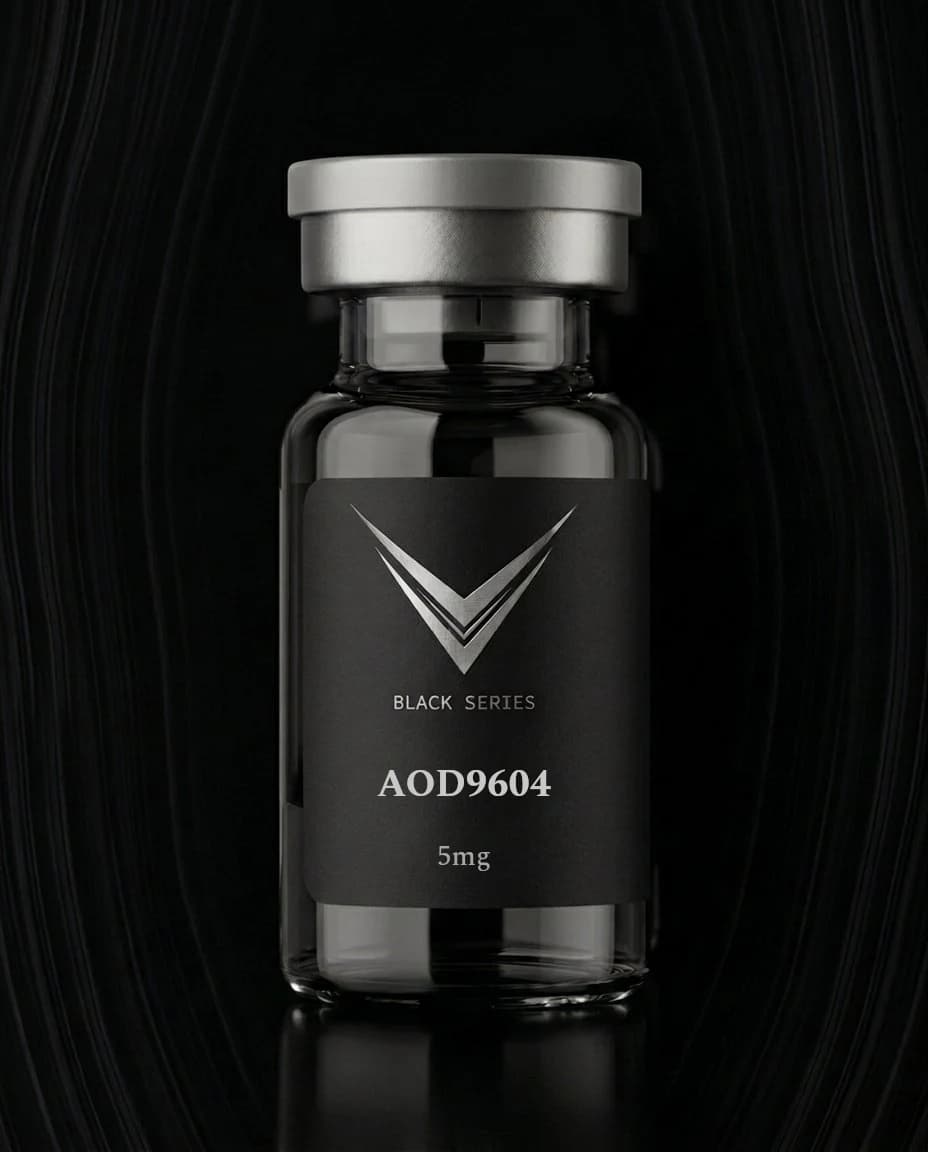
AOD9604 is a synthetic peptide studied in laboratory research as a modified fragment of human growth hormone (hGH). It corresponds to the C-terminal region of the hGH molecule, with an added tyrosine residue at the N-terminus, and it is catalogued under CAS number 386264-39-7. Black Series Lab lists AOD9604 with a molecular formula of C78H123N23O23S2 and a molecular weight of 1815.12 g/mol, supplied as a lyophilized powder for in vitro and laboratory research only.
The compound sits in the metabolic research category of the catalog. Its design logic is straightforward: take the portion of a large protein hormone that published structural work associates with a specific region of the parent molecule, reproduce it as a short synthetic peptide, and study that fragment on its own. That makes AOD9604 a useful reference material for researchers who want to examine fragment-level behavior without working with the full 191-residue parent protein.
What is the molecular structure of AOD9604?
AOD9604 is a 16-residue peptide. The core of the sequence is a fragment of hGH spanning the C-terminal region of the parent protein, and the added N-terminal tyrosine is a deliberate modification. Published structural descriptions explain that the extra tyrosine was introduced to support labeling and handling in analytical work rather than to change the fragment's identity. The peptide contains a disulfide bridge between two cysteine residues, which is why the sulfur count in the formula reads S2.
The catalog identifiers for the material are:
Property
Value
Compound
AOD9604
CAS number
386264-39-7
Molecular formula
C78H123N23O23S2
Molecular weight
1815.12 g/mol
Form
Lyophilized powder
Storage
−20°C
Purity specification
99%+ by HPLC
Black Series Lab does not publish a residue-by-residue sequence string on the catalog page, so this article does not restate one. Researchers who need a sequence for software input or mass-spec fragment prediction should take it from the batch documentation and verify it against the formula and molecular weight above.
Why does the fragment design matter for analytical work?
Short peptides are easier to characterize than full proteins. A 1815.12 g/mol species falls in a mass range where high-resolution mass spectrometry resolves the monoisotopic peak cleanly, where reverse-phase HPLC separates closely related impurities, and where a single mass error is large enough to see. For a quality-focused researcher, that matters. A truncated or mis-coupled sequence will show up as a mass shift that can be matched against the expected value.
The disulfide bridge adds a second layer. Oxidized and reduced forms of the same peptide differ by roughly two mass units, and an incompletely cyclized batch will show a split in the mass spectrum or a shoulder in the chromatogram. This is one reason a cyclic fragment is a good test case when evaluating whether a supplier's identity data actually resolves what it claims to resolve.
What does published research describe about AOD9604?
Published preclinical research describes AOD9604 in the context of metabolic signaling in cell and animal model systems. The reported rationale is that the C-terminal region of hGH was examined separately from the regions responsible for the parent hormone's growth-related signaling, so that fragment-level activity could be studied in isolation. Published discussions of the fragment characterize its behavior in lipid-metabolism models and note that it was designed to be distinct from the full hormone in its receptor-level profile.
Black Series Lab makes no therapeutic or outcome claims about AOD9604. The compound is offered strictly as a research chemical, and this article describes what the literature investigates rather than what the material does outside of a laboratory setting. Readers evaluating the published work should read the primary papers directly, pay attention to the model system and the concentration range used, and avoid extrapolating cell-model findings to other contexts.
How does AOD9604 compare with other metabolic catalog compounds?
The metabolic category in the catalog includes several structurally unrelated compounds, which is worth stating plainly because the category label groups them by research area, not by structure. AOD9604 is a small cyclic fragment. Peptides such as Cagrilintide are far larger lipidated analogs, and small molecules in the same category share nothing with it structurally.
For a quality workflow, this comparison has a practical consequence. Reference standards for one compound cannot stand in for another, and mass ranges that overlap poorly mean that a mislabeled vial is usually detectable by mass alone. A researcher who receives a vial labeled AOD9604 and finds a dominant peak near 4409 has a labeling problem, not a purification problem.
What analytical documentation should accompany AOD9604?
A credible batch record for a research peptide should include, at minimum, an HPLC trace with the integration table visible, a mass spectrum showing the observed mass against the theoretical value, the batch or lot number tied to the physical vial, and a test date. For AOD9604 specifically, the expected neutral mass is 1815.12 g/mol per the catalog value, and observed values should agree within the instrument's stated tolerance.
Several checks are worth running on any certificate:
The compound name, CAS number, and molecular weight on the document match the catalog entry.
The chromatogram is an actual trace with a baseline, not a table of numbers with no image.
The purity figure comes from an integrated area-percent calculation that can be traced to the plot.
The lot number on the document matches the lot on the vial label.
A certificate that fails any of these checks is a reason to request clarification before a material enters a study. Black Series Lab's general guidance on reading these documents is covered in COA red flags.
What stability and handling considerations apply to AOD9604 in research?
AOD9604 is supplied as a lyophilized powder and stored at −20°C. As a peptide containing a disulfide bridge, it is subject to the usual peptide degradation pathways, including oxidation and hydrolysis. Cold storage, protection from moisture and light, and minimal freeze-thaw cycling in the lyophilized state are the general principles in the stability literature for compounds of this class.
This article does not provide reconstitution or preparation protocols. Handling decisions are made by the researcher according to the requirements of the study and applicable regulations, and records of storage conditions should be kept with the batch documentation so that any later identity re-test can be interpreted correctly.
How does Black Series Lab supply AOD9604?
Black Series Lab supplies AOD9604 as a research-grade compound at a minimum purity of 99%+ by HPLC, with mass spectrometry identity confirmation, and each batch is documented with a Certificate of Analysis. Researchers can review the current size and pricing on the AOD9604 product page or browse the full catalog at all compounds. Comparative sourcing considerations are discussed in peptide sourcing quality tiers.
All material is intended for laboratory research use only and is not for human use.
This compound is a research chemical intended for laboratory and scientific research purposes only. It is not a drug, supplement, or food, and is not intended to diagnose, treat, cure, or prevent any disease. Black Series Lab does not sell products intended for human use. Researchers are responsible for compliance with all applicable local, state, and federal regulations.
Stay in the loop
New compounds, research updates & exclusive subscriber deals.