Amino Axiom is a free research information platform covering a compound library, price comparison, a vendor directory with status tracking, a compare tool, a glossary, community discussion, articles, and keyword search. The iOS app is the native version of that platform, available from the App Store listing. It carries the same compound library, prices, and community as the web version, packaged for a phone.
This article looks at the app from one angle: quality standards. The question is how a researcher who cares about identity, purity documentation, and specification consistency can use a reference app as a cross-check against a supplier's own catalog. The app is a research information and tracking tool. It does not replace a Certificate of Analysis, and nothing here describes use of any compound.
Why would a quality-focused researcher keep a reference app on hand?
Specifications drift. A molecular weight copied into a spreadsheet three months ago, a CAS number retyped from memory, and a formula pasted from a vendor page can all contain small errors that propagate into a study record. A reference library that shows the same identifiers in a consistent layout makes it quicker to catch a mismatch, especially when the researcher is away from a desk and checking a vial label or a received document.
The practical use is verification, not discovery. The app shows what a compound page lists. The researcher compares that against the supplier's catalog entry and against the batch documentation. Any disagreement among the three is a prompt to ask questions before the material is logged into a study.
How do compound pages support a specification cross-check?
Each compound in the library has its own page. For a quality workflow, the fields worth reading first are the name and any listed synonyms, the CAS number, the molecular formula, and the molecular weight. These are the fields that can be matched mechanically against other documents.
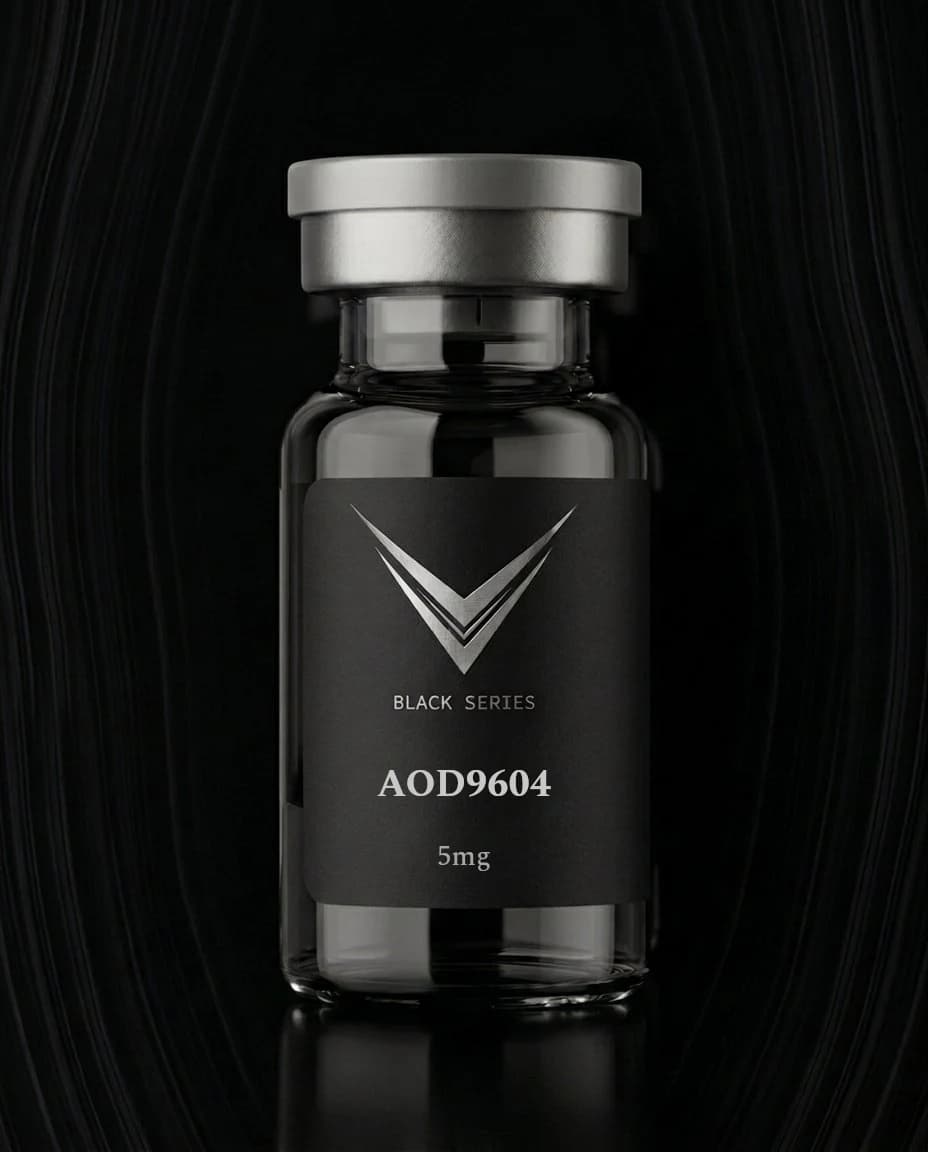
As a worked example, Black Series Lab lists AOD9604 with CAS 386264-39-7, formula C78H123N23O23S2, and a molecular weight of 1815.12 g/mol. A researcher can open the equivalent page in the app and check whether those four values agree with the catalog. If the app lists a different molecular weight, the likely explanations are a different salt or form, a rounding convention, or an error in one of the sources. Each is worth resolving, and none can be resolved by assuming the first source seen is correct.
A second example is Ipamorelin, catalogued at CAS 170851-70-4, formula C38H49N9O5, and molecular weight 711.87 g/mol. Because this is a short pentapeptide, the mass is small enough that a transcription slip shows up quickly. Comparing the two entries side by side is a ten-second sanity check.
How should a researcher read the vendor directory and status tracker?
The vendor directory lists suppliers along with a status indicator. From a quality-standards viewpoint, that indicator is one input among several, and it should be read as exactly what it visibly shows: a record of whether a listing is currently tracked as active, not an endorsement of any batch. It does not verify purity, and it does not substitute for reading the supplier's own analytical documents.
A reasonable reading order looks like this:
Identify the supplier and confirm the name matches the one on the paperwork.
Note the listed status and how recently it was updated.
Open the supplier's own catalog entry and compare identifiers with the library.
Request the batch Certificate of Analysis and check it against the same identifiers.
Treat any step that fails as a stop point. Black Series Lab's guide to COA red flags covers the document-level checks in more detail, including trace legibility, lot-number matching, and integration tables.
What does the compare tool add?
The compare tool places two compounds next to each other. For quality work its value is catching category confusion. Two compounds with similar-sounding names can differ by thousands of daltons, and putting the numbers side by side makes that obvious.
Consider CJC-1295 no DAC, catalogued at 3367.9 g/mol with the formula C152H252N44O42. Next to a short peptide such as Ipamorelin at 711.87 g/mol, the mass difference is a factor of nearly five. A researcher reconciling a received vial against an order can use that gap as a plausibility test: an analytical mass that lands near the wrong compound's value is a labeling problem, not a purity problem.
The same logic applies to blends and complexes, where a single molecular weight may not exist. Black Series Lab lists its blends with mixed values for that reason, and a reference app that shows a single clean number for a blend deserves a closer look at what the number represents.
How does the glossary help with documentation language?
Certificates and catalog pages use terms such as area-percent purity, monoisotopic mass, lyophilized, and free base versus salt. The glossary gives short definitions that a researcher can open mid-review. This is particularly useful for newer team members who are reading a mass-spec report for the first time and need to know why an observed mass differs from a catalog value by a counterion or a hydration state.
The glossary also supports consistency inside a lab. When everyone in a group reads "purity" the same way, batch comparisons are more reliable. A definition on the phone is a small convenience, but consistent terminology across a study record is a real quality benefit.
What are the limits of using an app for quality control?
An app is a reference, and a reference can be wrong or out of date. Several limits are worth stating plainly:
The app does not test any material. Only analytical work on the physical batch does that.
Listed identifiers are only as good as their sources, so a disagreement should be traced to a primary reference rather than settled by majority vote.
Prices and status can change after a page was last updated, and the researcher should confirm current information with the supplier directly.
Community posts are anecdotal and should not be treated as analytical evidence.
Used within those limits, the app is a quick second opinion on specifications. It is not a substitute for independent testing, a Certificate of Analysis, or the researcher's own judgment about a batch.
How does this connect to Black Series Lab's catalog?
Black Series Lab publishes its specifications openly so that they can be checked against outside references. Each compound page carries the CAS number, formula, molecular weight, purity specification, and storage condition, and each batch is documented with a Certificate of Analysis. Researchers can browse the full list at all compounds and compare it against any reference library, including the one in the app. Where the two disagree, the batch documentation is the controlling record.
All material is intended for laboratory research use only and is not for human use.
This content is for informational and research purposes only. Black Series Lab products are research chemicals intended for laboratory and scientific research purposes only. They are not drugs, supplements, or food, and are not intended to diagnose, treat, cure, or prevent any disease. Amino Axiom is an independent research information platform. Researchers are responsible for compliance with all applicable local, state, and federal regulations.
Stay in the loop
New compounds, research updates & exclusive subscriber deals.